
How to Size Your Solar Battery
Updated: 12 hours ago
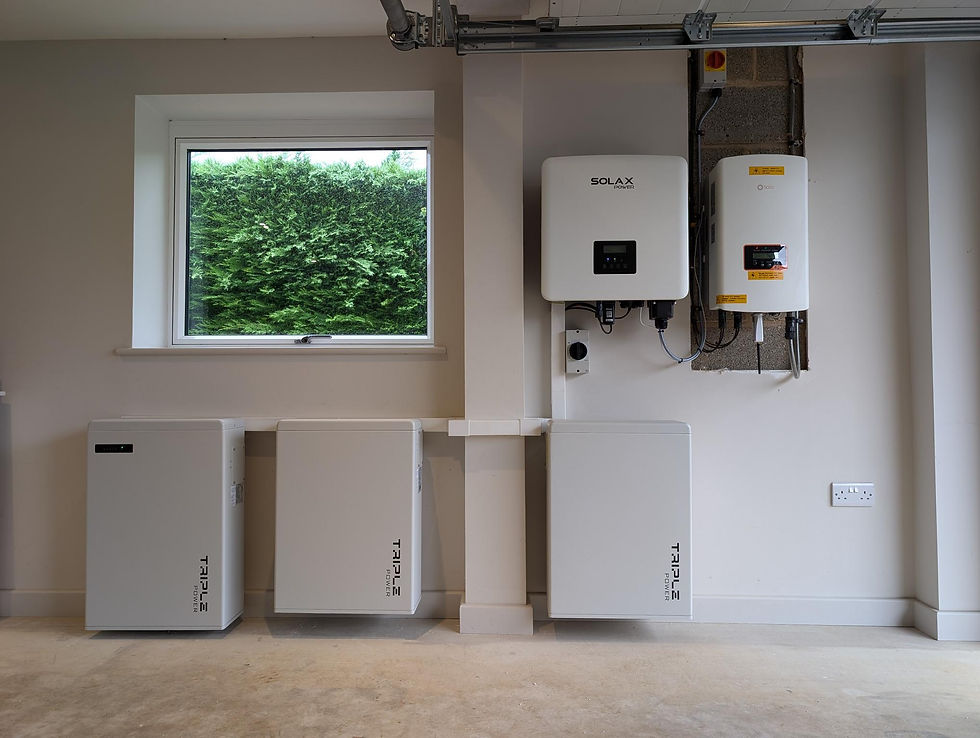
What Size Solar Battery Do I Need? A Simple Guide for South Wales Homes
If you're considering solar panels and battery storage, one of the first questions you'll probably ask is: What size battery do I actually need?
It's an important decision. Batteries represent a significant part of the installation cost, and choosing one that's too large could mean paying for storage capacity you rarely use.
At Ulex Energy, we believe the best battery isn't necessarily the biggest you can afford. It's the one that delivers the greatest value for your home.
The good news? There's a relatively simple way to estimate the right size.
How Does a Solar Battery Save Money?
A home battery can reduce your electricity bills in two ways:
Storing excess solar electricity: Rather than exporting all your unused solar generation, you can store some of it to use later, when electricity is more expensive.
Charging overnight at cheaper rates: With a suitable smart electricity tariff, you can charge your battery overnight and use that electricity during more expensive daytime and evening periods.
The important thing is that your battery doesn't need to cover all your household electricity consumption.
Some electricity will already be purchased cheaply overnight, while your solar panels will power appliances directly during daylight hours.
This is why sizing your battery purely around your average daily electricity consumption can lead to buying a larger battery than you actually need.
Our Simple Battery-Sizing Formula
For a home with solar panels, we can estimate the required battery capacity using three pieces of information:
Your annual household electricity consumption, excluding overnight EV charging.
How much electricity you use during cheap overnight tariff hours.
How much electricity your solar panels supply directly to your home.
Our indicative battery-sizing formula is:
Battery size (kWh) ≈ [(Annual electricity consumption × 85%) ÷ 365] − (Solar PV capacity × Direct solar factor)
Where:
85% represents the estimated proportion of household electricity used outside a typical six-hour overnight off-peak window. We use this as an initial assumption, not a fixed rule for every home.
Solar PV capacity is the size of your installation in kWp.
Direct solar factor is the estimated amount of solar electricity used immediately in your home each day, measured in kWh per day per installed kWp.
The direct solar factor depends on the size of your solar installation, your electricity consumption and when you're normally at home.
An example: A home using 4,500 kWh per year
Let's imagine your home consumes 4,500 kWh of electricity annually and you're installing 12 solar panels, providing 6 kWp of solar generation.
Step 1 – Calculate electricity consumption outside the cheap overnight period
4,500 × 85% ÷ 365 = 10.5 kWh per day
Step 2 – Deduct electricity supplied directly by solar panels
For this example, we estimate that your solar panels supply approximately 3.5 kWh per day directly to your home.
10.5 − 3.5 = 7.0 kWh
This suggests that a battery with approximately 7 kWh of usable storage would be a sensible starting point.
Of course, your electricity consumption varies throughout the year, so we would check this estimate against a detailed energy model before recommending a system.
Battery Size Guide: How Much Storage Could You Need?
To make things easier, we've prepared an indicative sizing table for homes in South Wales.
Find your annual electricity consumption in the first column, then look across to the number of solar panels you're considering.
Indicative Solar Battery Sizes
Annual electricity consumption | 8 panels (4 kWp) | 12 panels (6 kWp) | 16 panels (8 kWp) | 20 panels (10 kWp) |
1,500 kWh | 2.1 kWh | 1.8 kWh | 1.7 kWh | 1.5 kWh |
3,000 kWh | 4.8 kWh | 4.4 kWh | 4.1 kWh | 3.9 kWh |
4,500 kWh | 7.6 kWh | 7.0 kWh | 6.6 kWh | 6.2 kWh |
6,000 kWh | 10.7 kWh | 10.0 kWh | 9.4 kWh | 9.0 kWh |
7,500 kWh | 13.9 kWh | 13.0 kWh | 12.3 kWh | 11.8 kWh |
All battery sizes are usable capacity, not nominal capacity.
Important: These figures are illustrative starting points, not guaranteed optimal battery sizes. They assume 500 W solar panels, approximately 920 kWh of annual generation per installed kWp, 15% overnight electricity consumption and a household occupied for approximately half the working day.
The estimates use assumptions informed by MCS solar self-consumption guidance, with extrapolations for larger systems and higher consumption. They aren't official MCS battery-size recommendations.
You might also notice that some of the suggested battery sizes decrease as solar panel capacity increases. That's because a larger solar installation can meet more of your daytime electricity demand directly, leaving less electricity to be supplied by the battery on an average day.
However, larger solar arrays also produce more surplus electricity that could be stored, which is why detailed modelling remains important.
Why Bigger Batteries Don't Always Save More Money
You might reasonably think that installing twice as much battery storage would provide twice the savings.
Unfortunately, that's rarely the case.
The main reason is that your electricity consumption and solar generation change throughout the year.
In winter, your solar panels generate less electricity and your household consumption may be higher. A larger battery can be useful, particularly when charged using cheaper overnight electricity.
In summer, your solar panels generate significantly more electricity, often powering much of your home directly. You may only need a relatively small amount of stored electricity overnight.
As a result, a large battery might be useful during winter but remain partly unused for much of the summer.
And remember, storing electricity isn't completely loss-free: some energy is lost when charging and discharging.
What About Selling Battery Electricity Back to the Grid?
Some smart tariffs let you buy electricity cheaply overnight and export it to the grid when prices are higher.
This can generate additional savings, but we wouldn't recommend investing in a much larger battery purely because today's export rates look attractive.
Electricity tariffs and export payments can change. We prefer to size batteries primarily around your household's own electricity needs, treating potential export earnings as an additional benefit rather than something to rely on.
What If You Want a Battery Without Solar Panels?
You don't need solar panels to benefit from home battery storage.
A battery-only system can charge during cheap overnight tariff periods and supply your home when electricity prices are higher.
The initial sizing calculation is even simpler because there's no direct solar generation to deduct:
Battery size (kWh) ≈ (Annual electricity consumption × 85%) ÷ 365
For example, if your home consumes 4,500 kWh annually:
4,500 × 85% ÷ 365 = 10.5 kWh
This suggests that a battery of approximately 10 kWh usable capacity could be a sensible starting point.
However, the best size depends on your electricity tariff, charging window and actual consumption throughout the day. A smaller battery may offer a better financial return.
Four Things to Check Before Choosing Your Battery
1. Usable capacity, not advertised capacity
Some manufacturers advertise the total or nominal capacity of their batteries, rather than the energy you can actually use. For example, a 10 kWh battery with 90% usable capacity provides just 9 kWh. Always compare batteries using their usable capacity.
2. Charging and discharging power
Battery capacity is measured in kWh, while charging and discharging power is measured in kW.
A large battery is only useful if it can charge sufficiently during your cheap tariff window and provide enough power for your household appliances.
3. Future electricity consumption
Are you considering a heat pump, electric vehicle or home extension?
These can affect the most appropriate battery size. Electric vehicles are normally best charged directly using cheap overnight electricity or excess solar, rather than unnecessarily cycling energy through your home battery.
4. Backup power and expandability
If you want your battery to provide electricity during a power cut, you'll need compatible equipment and may want to keep some storage in reserve.
It's also worth considering modular systems that allow you to add more battery capacity later if your needs change.
How Ulex Energy Finds the Right Battery Size
Our initial formula and sizing table provide a useful starting point, but they don't replace a proper system design.
At Ulex Energy, we take a more detailed approach before recommending a battery:
We review your annual electricity consumption and when you normally use electricity.
We assess the expected solar generation based on your roof's orientation, pitch and shading.
We consider your electricity tariff, including opportunities to charge cheaply overnight.
We compare different battery sizes using energy modelling to estimate annual savings.
We assess whether paying for additional battery capacity is likely to provide a worthwhile financial return.
This last point is particularly important. A larger battery may reduce your grid electricity consumption further, but if the additional savings are small compared with its cost, it might not be the best investment.
Our aim is to recommend the battery that gives you the best balance of cost, savings and long-term flexibility — not simply the largest battery we can sell you.
Ready to Find the Right Battery for Your Home?
Whether you're considering a new solar and battery installation, adding storage to existing solar panels, or installing a battery without solar, we can help.
Ulex Energy is an award-winning, MCS-certified solar and battery installer based in Swansea, covering South Wales.
We design bespoke systems around your home, your electricity consumption and your financial objectives.


Comments